In the ancient world, the ideal of female beauty derived from a Greek canon, from marble sculpted deities by artists who modeled the best  features of various women to create a virtual, ideal and absolute beauty. This ideal beauty, combined with the hairstyles and clothing of the classical tradition, has always been well represented artistically  in Pompeian painting and sculpture.

A work of art which can be considered a real cultural icon of Greek beauty is the famous “Venus  Anadyomene” (from Greek, “Venus Rising From the Sea”), the goddess of love, depicted in the act of rising from the sea and resting her hands on wet hair. Originally it was created by the famous Greek painter Apelles in the 4th century B.C. for the Asklepeion, the temple dedicated to Asclepius, on Cos,  a Greek island facing Turkey. According to the different versions of the story, either Phryne, the model used by the great artist was a very famous hetaera [ among the Greeks, a courtesan, normally a stranger, free or a slave, elegantly dressed and, in general, rather highly cultured], or Campaspe, lover of Alexander the Great.

The painting was later brought to Rome by Augustus, and placed in the Temple of Venus Genetrix, to evoke the mother of the “gens Iulia” (Strabo 14.2.19). However this masterpiece of Greek art was also very famous in the area of ​​Mount Vesuvius. This is confirmed by an inscription found in Pompeii where the scriptor, the writer, compared his beloved to the Venus of Apelles (CIL IV 6842 = CLE 2057): Si quis non vidi(t) Venerem quam pin[xit Apelles] | pupa mea aspiciat: tali set i[lla nitet].

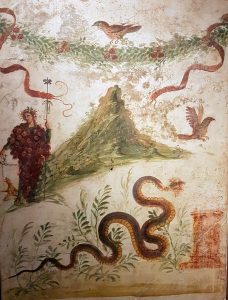
The wide diffusion of this model is confirmed by the dozens of copies of the Venus  Anadyomene spread among all the social classes of the population, at various artistic levels, from marble and bronze statues, as well as wall frescoes (such as in Pompeii in the House del Prince of Naples – see photo), but it is above all in the decoration on small tools of instrumentum domesticus, in particular on hair pins, where she was represented. Sculpted in bone, they were relatively inexpensive and multi-purpose instruments, widespread even in modest-sized houses, ubiquitous in female beauty care: they served as sharp instruments for applying makeup and also for dividing and styling hair. The hair pins  could remain fixed in the hair to be within easy reach in case of need and were also portable amulets. Such a hair pin, together with an amulet pendant also in the shape of Anadyomene, was found in the house of L. Elvio Severo in Pompeii (1). In addition, the box for ointments and toiletry items in the Imperial house in Pompeii was secured by a bronze padlock in the shape of the same goddess. (2)


BIBLIOGRAPHY:

  1. Berg, “Donne medico a Pompei?”, in A.Buonopane, F. Cenerini (a cura di), “Donna e lavoro nella documentazione epigrafica” , Atti I seminario sulla condizione femminile nella documentazione epigrafica (Bologna, ottobre 2002), Faenza 2003, pp. 131-154
  2. Ria Berg  “Attrarre” – in Massimo Osanna e Carlo Rescigno, “Pompei e i Greci”, Electa 2017, pp. 213-214
 

For further info about our guided tour of Pompeii

In 1731 King Charles of Bourbon inherited the famous “Farnese collection” from his mother, Elisabetta Farnese. When the enlightened sovereign ascended the throne of Naples in 1734, he took these splendid works of art with him in dowry to the Parthenopean city. Charles furthermore ordered the excavations of Herculaneum (1738) and Pompeii (1748), which led to the discovery of an impressive number of Roman Art treasures.

However it was only in 1777 that Charles’s son, Ferdinand IV of Bourbon, determined by decree to gather these great dynastic collections, (Farnesian, Pompeian and Herculaneum) together in the  “Palazzo dei Vecchi Studi” (the Old University) and earmark them for public use. Moreover, this new building was envisaged as an encyclopedic museum where all human knowledge should be situated: works of art, books, papyri, studios  and even an astronomical observatory. Following the dominant Enlightenment culture, the educational aspect of this museum and its importance as a public utility were emphasized. Consequently,Ferdinand intended to bring together workshops, laboratories, painting, sculpture, and restoration schools and more. It was aimed to create a museum-workshop-school in the building. However, in order to do this, the old “Palazzo degli Studi” required profound changes and, in 1806 when the French arrived, the building was still under restoration.

During the French domination, first Giuseppe Bonaparte, and then Gioacchino Murat, abandoned the museum’s encyclopedic project for nearly 10 years, “reducing” it to a simple venue for the exposition of the imposing Farnese and Bourbon collections.

During  the Napoleonic period, all the leading museums in the territories conquered by the French armies were stripped of their most important masterpieces which were channelled  to the Louvre Museum in Paris. But the Archaeological Museum of Naples (like the Brera Museum in Milan) did not suffer from depletion; in fact it was enriched with famous masterpieces.

Murat sought an autonomous kingdom in Napoleonic Europe. The new director of the Museum, Michele Arditi (1807-1838), immediately showed his worth: first of all he introduced  more severe management of the personnel compared to the previous state of disorder; the obligation and control of daily working hours; respect for a precise work timetable and the prohibition of objects being taken out of the Museum. After the fall of  Murat (1815), during the Bourbon restoration, Ferdinand I again confirmed Michele Arditi as director of this institution which was growing continually.

What clearly made the difference between French and Bourbon management of the Archaeological Museum  was that, with his return, King Ferdinand I explicitly stated that the collections of the Archaeological Museum were his “allodial property” and therefore alienable. The royal sites belonged to the Crown – and were therefore not saleable, – but the collections were property of the king (and therefore privately owned). The idea advanced by the French kings, that artistic masterpieces were  protected by the State, was therefore denied by this declaration of Ferdinand I.

The restored Bourbon monarchy maintained  the original educational and public purpose of the Archaeological Museum of Naples, but at the same time it displayed a mentality not in line with the most modern Enlightenment principles.

Later, only in 1822, would the transfer of the archaeological artifacts from the “Herculaneum Museum” of Portici be completed, but despite all efforts, the Royal Bourbon Museum continued to seem  an overcrowded repository  without any precise exhibition criteria. Infact, the first extensive re-organization only took place during the Unification of Italy under the decisive intervention of Giuseppe Fiorelli.


Excerpt from:  Nadia Barrella e Ludovico Solima, Musei da svelare, Luciano editore, Napoli, 2011, pp. 17-23   

For further info about our guided tour of the National archaeological Museum of Naples

In general, however, the ancient Mediterranean populations, in founding the cities, took into account from the outset the prospect of demographic growth and strengthening of the settlement. For example, in Magna Graecia, most of the “poleis”, the cities, developed over the centuries within the limits defined at the time of the foundation – very rare exceptions are Taranto and Syracuse. (9)     Therefore, up until the beginning of the eighties of the last century, Pompeii seemed not to align itself with the most common types of walls at that historical moment. But in 1982 Stefano De Caro, director of the excavations of Pompeii from 1982 to 1984, decided to resume a series of excavations in the Vesuvian city both in the Northern sector of the fortification, near the Tower XI, and in the Southern one, in the stretch between “Porta Nocera” (Nocera Gate) and the Tower IV. The results obtained are one of the most important acquisitions for the reconstruction of the urban history of Pompeii. The Neapolitan archaeologist discovered a primitive city wall in local tufa rock, the so-called “pappamonte”, elaborating the hypothesis that in Pompeii three different wall circuits would have been superimposed: the oldest – precisely discovered by De Caro – dating back to the VI century BC., the second building circuit dating back to the IV century BC, and the third, the one visible today, dating back to the end of the II century BC     However, of particular interest is the fact that, according to De Caro, the first city wall, the one dating back to the VI century B.C. in “pappamonte”, extended almost as much as the whole area included in the subsequent Samnite fortification. In doing so, it contrasted the then more established theories, which hypothesized the existence of a first housing nucleus in a much more restricted area. (10)    Moreover, recent investigations in the courtyard of the “Stabian Baths” in Pompeii confirm that the cultural model of the German scholar Eschebach of 1979 must be completely revised: there is no evidence of remains from the Archaic period (roads, gates, fortifications) (11).


BIBLIOGRAPHY:

9. Gioacchino Francesco La Torre, op. cit., pag.158

10. Marco Fabbri, Difendersi, in Massimo Osanna e Carlo Rescigno, Pompei e i Greci, Electa, 2017, pag. 269

11. Monika Trümper, op. cit., pag. 265


For further info about our guided tours of Pompeii and Herculaneum


The perimeter of the city walls of Pompeii is 3220 m and has seven recognized gates; of an eighth – Capua Gate – it was assumed the existence based on a possible symmetry in the position of the gates. (1) Like any city in the ancient world, the walls of Pompeii were of particular importance because, in addition to performing a defensive function, they also marked the passage between the urbs (city) and the ager (countryside), between citizens and those who were not yet citizens (the indigenous rural population, for example) or those who were no longer (the deceased). The city walls were impassable because they were untouchable in the religious and legal sense of the term. The jurist Gaius, active between the reign of Hadrian and that of Marcus Aurelius (2nd century AD), used the term “res sanctae” (sacred property) to indicate the walls and their gates. (2) To justify and legitimately base the appropriation of a space which was completely removed from the domain of Nature, a divine origin sanctioned in its own settlement with its walls in order to directly involve the Gods in the fate of the city. (3) In Greek times in many cases – in Magna Graecia we know the cases of Locri and Agrigento – the sacred areas were located along the route of the city walls, both internally and externally, to constitute the best known cases of “ceinture sacrée” (sacred city walls), according to a lucky definition by François de Polignac. In practice, the whole city was physically placed under the protection of the Olympian Gods, through a widespread distribution of sacred areas along the perimeter of the city walls, above all at the gates. (4)

It is surprising how this description of “ceinture sacrée” can be perfectly found even in Pompeii. In fact, with the exception of the “Capitolium”, obviously located in the Forum, all the main sacred sanctuaries (Temple of Apollo, the Triangular Forum, Temple of Aesculapius or Jupiter Meilichios, the Temple of Venus) lie by two of the seven city gates, the so-called “Marina Gate” and “Stabian Gate”.

Furthermore, city gates marked a border that was often demarcated not only by physical defenses (towers, ditches, gates), but also by symbols that evoked a magical protection of urban space (sacred images, apotropaic symbols) (5). Interesting in this regard is what was found, for example, in the niche at the main archway of Porta Marina in Pompeii: a fictile statue of Minerva, guardian goddess of the city gates. (6)

For what concerns the first urban nucleus of Pompeii, until a few decades ago, it was thought that it was much more limited and its walls developed around the “Vicolo del Lupanare”, “Vicolo degli Augustali” and ” Vicolo dei Soprastanti ”, which is the closest territory to the current Forum. This theory was also reinforced by the presence, in the aforementioned area, by urban planning oriented in a different way from the rest of the city. It was then thought that, later, around the fifth century BC, the city had developed towards the East and North. In other words, it was believed that, after an initial urbanistic phase where Pompeii developed to just 9.3 hectares, it later developed to 63.5 hectares. (7)

To crown the aforementioned theory, in 1979 the German scholar Hans Eschebach published an authoritative monograph, which stated that in the 6th century BC, where today the “Stabian Baths” rise, the fortifications ran with a moat and a city gate. (8)


BIBLIOGRAPHY:

  1. Eugenio La Rocca, Mariette e Arnold de Vos, Guida archeologica di Pompei, Arnoldo Mondadori Editore, 1976, pp. 85
    2.  P. Gros, L’architettura romana dagli inizi dal III secolo a.C. alla fine dell’Alto Impero: i monumenti pubblici, Milano, Longanesi & C. 2001, pag 28
    3.  Giuseppe Gisotti, La Fondazione delle città, Carocci Editore, 2016, pp. 17-18
    4.  Gioacchino Francesco La Torre, Sicilia e Magna Grecia, Editori Laterza, 2011, pag.299
    5.  Giuseppe Gisotti, op. cit. pag. 18
    6.  Fabrizio Pesando, Maria Paola Guidobaldi, Pompei, Oplontis, Ercolano, Stabiae, Guide Archeologiche Laterza, Bari, 2018, pag. 31
    7.  Eugenio La Rocca, Mariette e Arnold de Vos, op. cit., pp .12-13
    8. Monika Trümper, Curare se stessi, in Massimo Osanna e Carlo Rescigno, Pompei e i Greci, Electa, 2017, pag. 265


For further info about our guided tours of Pompeii and Herculaneum

The name “Vesuvinum” has been found on wine amphorae in both Pompeii and in Carthage. “Pompeianum” and “Surrentinum” (from Sorrento) were both known in Rome. Pompeian wine amphorae have also been found in Ostia (Italy), Ampurias (Spain), Alesia (Gaul), Vindonissa and Augst (Switzerland), Trier (Germany), and even in Stanmore, Middlesex (Britain). At Carthage more than 40 amphorae were found in a dump dating from c. 43 to 25 BC with the stamp of L. Eumachius, probably the father of the famous Pompeian priestess Eumachia. In the same dump there were six other examples of amphorae stamped with known Pompeian names.
Also the Vetti brothers (Aulus Vettius Restitutus and Aulus Vettius Conviva) seem to have been great wine merchants, as shown by Matteo della Corte. Thus the figure of Priapus (see Note below), son of Dionysus, placed at the entrance of the beautiful residence, becomes very significant. And even the basket at the feet of the god, filled with fruit among which grapes are the most important, becomes a clear allusion to the prosperity of the funds and vineyards of the Vetti, source of their riches. (1)

Also noteworthy is the Termopolium of Vetutius Placidus, an example of social mobility. At the time of discovery, archaeologists found in 683 sesterces (3 kg). This is one of the few cases in which it is almost certain that that sum constituted the actual collection of the day. (2)

NOTE:
Priapo = God of Nature’s fertility, he was a native of the Middle East. He was called the son of Aphrodite and Dionysus or another son of Chione [In Greek mythology, Chione was the daughter of Boreas, the god of the North wind] and Dionysus.

BIBLIOGRAPHY:
1) Matteo della Corte, Case ed abitanti di Pompei, Fausto Fiorentino Editore – Napoli, 1965, pag.70
2) Eugenio La Rocca, Mariette e Arnold de Vos, Guida archeologica di Pompei, Arnoldo Mondadori Editore, 1976, pag. 217

For further info about our guided tours of Pompeii and Herculaneum

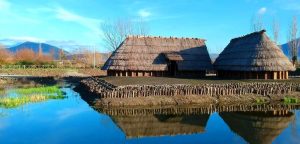
The huts, of varying sizes and often enclosed by a fence, were generally almost rectangular in shape with one of the short apsidal sides, generally open on the long side, with two aisles and a gable roof. Inside each structure there was a hearth, but often a larger oven was also installed externally for production purposes. The settlement of Poggiomarino, in fact, since the most ancient phases of the Iron Age (IX – VIII century BC), was characterized by handicraft activities of metal, bone, glass paste and amber artifacts, taking shape therefore as an important center of production and exchange of prestige goods. Archaeometric analysis on amber allowed us to confirm that this raw material came from other places, beyond the Baltic. For the “Orientalizing period” (VII century BC), a local fusion activity of metals was also ascertained in Poggiomarino, and isotopic analysis (Isotopengéologie Laboratory of the University of Bern) on lead confirmed that this metal was imported both from South-western Sardinia and from southern Spain (Rio-Tinto Huelva and / or Alpujarride region).

Textile activity, of a domestic nature, must have been fundamental for the local community, as numerous loom weights were found for weaving.

The subsistence economy of this community was mainly based on agriculture and livestock, however, in Poggiomarino, hunting and fishing activities are also documented – irrelevant though, from an economic point of view.

Furthermore, we know that the ancient inhabitants of these marshes also collected spontaneous fruits such as hazelnuts, blackberries, carnelians and – as fodder for the breeding of animals – acorns and oak-galls. There was also a cultivation of cereals and legumes (broad beans), as well as the pressing of grapes to produce wine. Numerous grape seeds were found whose morphobiometric study (dr L. Costantini) confirmed their origin from fruits of cultivated vines.

Also the analysis carried out on the faunal remains (animal bones and malacofauna – which is mollusks) have provided very significant information. The bone remains attributed to domestic animals (cattle, sheep and goats and pigs, but also horses and dogs) are predominant compared to those attributed to wild species (deer and wild boar). Livestock breeding therefore played a primary role in the subsistence economy of Poggiomarino, as cattle, sheep and goats and pigs were the main source of meat to which must have been added, albeit modestly, that from wild mammals and birds. Pigs were only bred for meat production while other domestic animals also provided other resources: cattle had great importance in agricultural work and sheep and goats were exploited for wool, and large and small ruminants could supply skins, horns and bones to work, but also milk for dairy production. As for the horses, of rather limited number, it was thought that their meat did not fit into the eating habits of the local people, and they were used as mounts or draft and loading animals. Among the wild animals the deer is the most widely attested above all through the presence of antlers (the branched appendages of the cervids), some of which were worked. Among the birds, there were animals related to the fluvial-marsh environment such as ducks (geese and ducks) and waders. Otters and turtles are also attested in Poggiomarino – portions of carapace (turtle shell) and plastron (ventral bone plate of the turtle shell) were found. The collection of turtles was evidently for food purposes.

The archeomalacological investigations (studies of ancient mollusks through the observation of the shells) have identified the presence of fresh water, continental and marine mollusks. The first two species were probably collected around the site for food purposes while for marine species they apparently came from sandy bottoms of the ancient mouth of the Sarno river. The perforation of a large number of valves and the shaping of anthropogenic origin of some shells attest to their use for ornamental or ritual purposes. The remains of ichthyofauna (the fish life of this region) are scarce, but the discovery “in situ” (on site) of numerous bronze hooks and net weights confirm the activity.

A very interesting datum emerged from the analysis conducted on some samples of pebbles found in very large quantities in Lòngola: they came from Ischia and from Sardinia. The hypothesis has been advanced by G. Di Mais according to which this material would have been used as a ballast for boats that arrived empty at Poggiomarino and would then leave full of cereals from there – during the Iron Age the entire plain of Sarno had wheat and cereals growing on it – or even prestige goods.

The huge amount of wood recovered in the village of Lòngola, above all poles and boards for the reclamation and regimentation of the banks of the canals but also structural elements required xylological analysis (xylology = study of wood): the genus “Quercus” (oak tree) was the most represented , both for the excellent characteristics of resistance and, obviously, for the abundant availability in the areas surrounding the settlement. In Poggiomarino, this species had very wide and well-spaced growth rings, typical of trees grown in a damp plain forest, but there is no lack of oaks with more rings, coming from the nearby mountains. Very significant is also the use of boards made of white fir wood, with good durability, which came from areas quite far from the site; this shows an ability to select the material according to the specific need for use. (1)

NOTE:
Magna Graecia (Megalē Hellas) refers to the coastal areas of Southern Italy which were colonized by various ancient Greek city-states from the 8th to 5th centuries BC

BIBLIOGRAPHY:

1) Caterina Cicirelli, Stato delle ricerche a Longola di Poggiomarino: quadro insediamentale e problematiche, in Pietro Giovanni Guzzo e Maria Paola Guidobaldi, Nuove Ricerche archeologiche nell’area vesuviana (scavi 2003-2006), Atti del Convegno Internazionale, Roma 1-3 febbraio 2007, L’Erma di Bretschneider, 2008, pp. 476-480


For further info about our guided tours of Pompeii


In the summer of the year 2000, during the construction of the Poggiomarino/Striano (Naples) wastewater treatment plant, in Lòngola di Poggiomarino scholars discovered an exceptional wetland settlement occupied since the Middle Bronze Age (XVI-XIV century BC) until the beginning of the VI century B.C.

The site of Lòngola is located in the upper valley of the Sarno river, near the current course of the same river, a little over ten kilometers east of Pompeii, in an area surrounded by the Iron Age necropolis (IX- VIII century BC) of Striano, San Marzano, San Valentino Torio and Poggiomarino. The plant was eliminated in 2004 and the Superintendency of Pompeii took possession of the entire area to carry out archaeological research. (1)


 WHY  IS THE DISCOVERY OF LÒNGOLA OF POGGIOMARINO SO INTERESTING?

It is a partial pile-dwelling settlement near the banks of the Sarno river, which brought us into one of these villages inhabited by the “Sarrastri”, people who founded Pompeii later. Those villages were made up of artificial islets, and their inhabitants created pile dwellings and moved among them trading, entering then already in contact with the Greeks. There we found indigenous ceramics, local ceramics, but already in these high chronological levels – we are in the course of the Iron Age [IX – VIII century B.C. – the period characterized by the use of iron metallurgy, especially for the manufacture of weapons and tools] – imported Greek ceramics. The “Magna Graecia” merchants went up the mouth of the Sarno river  and reached these inhabited areas along the middle and upper valley of the Sarno river. These inhabitants met  Greeks from “Magna Graecia”(See Note): Greeks from  “Pithecusae” (Ischia) (2), “Cuma” (Kyme) in the “Phlegraean Fields”, “Sibari”. In the valley of the Sarno the river people moved by “lontri”, a kind of pirogue, made from great trunks of great trees which allowed goods and people to move easily from one small island to another and from one river point to another. The Lòngola excavations took place in a humid situation which allows the preservation of  wood. In practice the presence of a water-table has favored the formation of an anaerobic environment which has allowed an optimal conservation of the organic matter in the village, in addition to a high number of both ceramic and metallic finds. Therefore Lòngola has given up a large quantity of wood (the wood of the palafittes, the floors of the huts) including two pirogues, always closed in the warehouses, in a casket coffin which is able to stabilize the hygrometric parameters (such as humidity parameters).


Numerous bone and horn objects were found, mainly of the deer family (needles, spatulas, awls, dagger handles, pins, pendants).


We have seen that since the earliest phase, the inhabitants of those villages covered the islets with thin reed walls belonging to disused huts, and to extend them, wooden boards were stuck vertically in the sand which delineated a new space in the water and then they filled it with heterogeneous material. Plant twigs and mats were then used as water insulators. But this was not enough: we have seen that, due to hydro-geological variations, it was necessary to periodically raise the floor of the houses.


NOTE:

Magna Graecia (Megalē Hellas) refers to the coastal areas of Southern Italy which were colonized by various ancient Greek city-states from the 8th to 5th centuries BC


BIBLIOGRAPHY:

  1. Caterina Cicirelli, Stato delle ricerche a Longola di Poggiomarino: quadro insediamentale e problematiche, in Pietro Giovanni Guzzo e Maria Paola Guidobaldi, Nuove Ricerche archeologiche nell’area vesuviana (scavi 2003-2006),  Atti del Convegno Internazionale, Roma 1-3 febbraio 2007, L’Erma di Bretschneider, 2008,  473
  2. Pier Giovanni Guzzo “Pompei, Magna Grecia”, in  Massimo Osanna e Carlo Rescigno, “Pompei e i Greci”, Electa 2017 – p. 56


For further info about our guided tours of Pompeii


79 A.D. ERUPTION OF MT VESUVIUS


A decade or two later the poet Statius lamented, “In the future, when crops grow again and this devastated wilderness blooms once more, will people believe that towns, people and estates are all buried beneath the soil?”(1).


August 24

At 1,00 pm, after a long rest, Mount Vesuvius suddenly began its explosive activity without any warning which could have given some clue to the inhabitants of Pompeii of what was to follow. Had there been such a warning then, perhaps such a huge loss of life could have been avoided. The telluric movements, which preceded the final disaster, were simply perceived as earthquakes, a typical feature of that territory. The eruption began with a terrifying noise: a lava cap was blown away.

Along the volcanic conduit molten magma came up, which, due to the abrupt release of the gas, became volcanic foam, expanding rapidly and rising to the surface up fragments. The column of gas, ash and pumice stones reached 15 km in height; the cloud, carried by winds in altitude, was dispersed over a very large area in South-East direction, with simultaneous rain of ash over Pompeii and Stabiae. Only a very small part of it rained over Herculaneum, where the volcanic stratigraphy reveals the presence of a thin layer of pumice stones. (2)

At 5,00 pm, The pumice stones, which reached a height of about 50 cm, destroyed the roofs of the houses with their weight. Some of the inhabitants began to flee from the city, searching in the dark “which hides things like when you are in a closed room with lights off” (Pliny the Younger, Letters to friends, VI, 20, 14) and they started to suffer from suffocation crisis due to the dense and warm air that accompanied the emission of ash. (3)

At Midnight, The volcanic column reached a height of 30 km: Mount Vesuvius started to emit 200,000 tons of fragmented magma per second.


August 25

At 1,00 – 2,00 am first collapse of a volcanic column took place, and its top lowered about 20 km. The first surge (incandescent cloud), with a temperature of about 400 degrees centigrade and a speed of about 80 kilometers per hour (10/20 meters per second) reached Herculaneum and caused instant death, by thermal shock, of its inhabitants who were seeking refuge at the beach. (4)

At 2.00 am – 6.00 am At dawn, the emission of pumice decreased, allowing the escape from the city of those who were still able to leave their homes or temporary shelters.

At 6.30 am A renewed eruptive activity caused a surge (S3) that reached Pompeii, stopping along the northern side of the walls; those people who were outside died, in the villas of the Mysteries and Diomedes and the fugitives outside of the Herculaneum Gate.

At 7.30 am Two surges (S4 and S5), which originated within a short time of each other, passed over the wall and hit the city. It was the moment of the death of the Pompeians who remained in the city or were surprised while escaping. Pyroclastic clouds also reached the Moregine area and the fluvial port of Pompeii, located at the mouth of the Sarno river. (5)

In about 20 hours of activity Mt Vesuvius spewed 10 billion tons of magma and hundreds of millions of water vapor and gases out, at a speed of 300 meters per second.

Ancient Herculaneum remained buried under a thick blanket of pyroclastic material, mud and surge between 16 and 30 meters high, above which, in the area of Villa dei Papiri, the lava of the 1631 eruption also overlapped. (6)
Pompeii was buried under a thick rain of ash and pumice stones up to 6-7 meters high.
Today, both of these Roman towns give us an amazing cross-section of all the everyday aspects of Roman civilization. (7)


Bibliography:

1) Statius, Silvae, IV,4, pp. 78-85
2) Maria Paola Guidobaldi – Ercolano – Electa Napoli 2012 – p. 7
3) Fabrizio Pesando Maria Paola Guidobaldi, Pompei, Oplontis, Ercolano, Stabiae, Guide Archeologiche Laterza 2018, p. 14
4) Maria Paola Guidobaldi, op.cit. p. 7
5) Fabrizio Pesando Maria Paola Guidobaldi, op.cit. , p. 15
6) Maria Paola Guidobaldi, op.cit. p. 8
7) A. Maiuri – Pompei – Istituto Poligrafico dello Stato – MCMLXIV – XI edizione – p. 5


For further info about our guided tours of Pompeii


THE ETRUSCANS, THE GREEKS AND THE PHOENICIANS

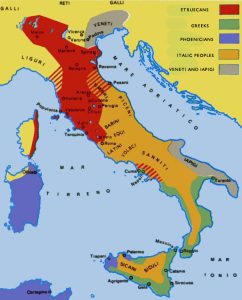
In the eighth century BC, the Italian peninsula, except for the Southern part, where the Greeks began to found colonies (Cuma in the second half of the eighth century BC, Sybaris at the end of the eighth century BC, as well as a few others), was inhabited by the so-called Italic peoples: Latins, Umbrians, Sabines, Piceni, Samnites, Iapigi, Messapi, Equi, Veneti, Liguri, etc., where the economic and cultural influence of the Etruscans was strong. The Italian territory was composed of a network of indigenous villages. (1)


For a mere academic schematization, we can outline 3 models of occupation of the  Italian territory, which were applied by the Etruscans, Greeks and Phoenicians.


ETRUSCAN MODEL: The Etruscans, with their arrival, favored new forms of urbanization by aggregating small scattered villages. Thus the so-called “Etruscan synoecism” takes place: this term  indicates the process of unification (2). A probable example was Pompeii, where the mythical people of Sarrastri, who previously lived on the banks of the Sarno river in villages of huts, were urged by the Etruscans to “unify” by founding the famous town of Campania.


GREEK MODEL: The other model is the one that spread in Southern Italy, “Magna Graecia” [and Sicily ed.], where the urbanization process was the opposite, because it started from a global vision of the urban planning. (3)The Greek settlers considered the “fertile soil” as the most important criteria in the selection of the site, since in most cases, to look for new lands to be cultivated, they had abandoned the motherland, afflicted by the increase in population, by the low quantity of production and quality of its soils (poor, being superficial and stony) and their intensive exploitation, which lasted for centuries. (4)Therefore this will determine the acquisition, sometimes violent, of the land at the expense of the natives. (5) Archaeological research has almost always documented that the Greeks systematically destroyed the indigenous villages in order to establish their settlements in Magna Graecia and Sicily.

PHOENICIAN MODEL:  The Phoenicians tended only to found emporiums for their trade with the local populations, with whom they usually entertained peaceful relations. (6). A notable exception is Carthage, which, in its long history, assumed a hegemonic role in the western Mediterranean. It maintained its great power until the time when, in the III century B.C., it clashed with Rome (Punic Wars).


BIBLIOGRAPHY:

  1. Giuseppe Gisotti, La fondazione delle città, Carocci Editore 2016 – pag. 26
  2. Ibid. p. 26
  3. Ibid.  p. 26
  4. Ibid. p. 22
  5. Gioacchino Francesco La Torre, Sicilia e Magna Grecia, Editori Laterza, 2011, p. 24
  6. Giuseppe Gisotti, op. cit. p. 20


For further info about our guided tours of Pompeii

THE NESTOR CUP

The so-called “Nestor cup” is one of the oldest examples of alphabetic writing and is now kept in the Archaeological Museum of Pithecusae, located in the “Villa Arbusto” complex at Lacco Ameno in Ischia (Italy). It is a drinking vase (a kotyle) of the late Geometric Rhodium Period (720 BC) discovered in Ischia in 1955 by Giorgio Buchner, the Italian-German archaeologist who carried out the excavations of San Montano (Lacco Ameno). He personally recomposed the various fragments that gradually emerged during the archaeological digs. That cup was part of the rich funeral treasure belonging to the tomb of a boy of about ten years of age. On the famous artifact a long inscription in retrograde hexameters (from right to left) is engraved, arranged on three lines, which says:


Nèstoros: […]: eùpot[on]: poterion
hòs d’àn tode piesi: poterì[o],: autìka kènon
hìmeros hairèsei: kalliste[fàn]o: Afrodìtes.


[I am the beautiful cup of Nestor, he who shall drink from this cup will immediately desire Aphrodite of the beautiful crown.]

This inscription thus evokes the pleasure of the cup of the mythical King Nestor of Pylos, described in Homer’s Iliad.


WHY IS THE NESTOR CUP SO IMPORTANT ?

The Nestor Cup is very important because it represents the oldest Greek literary text [in Magna Graecia]. (1)Moreover, this extraordinary find bears witness to the role of cultural “connector”      between the Greek world and the various indigenous peoples with whom, Pithekoussai established solid cultural, sd well commercial relations. Pithekoussai transmitted the Greek alphabet to other Italic peoples including the Opici, the Etruscans and the Romans (See note). When the Romans gradually conquered large areas of the ancient world, they spread the Greek alphabet, which had in the meanwhile been Romanized. Thus, writing started to spread from Pithekoussai, especially through the Romans, throughout the ancient world, and the most emblematic literary text is the Nestor Cup. In addition, the Nestor Cup inscription represents the first fragment of written text contemporary to that of the Iliad, the famous epic poem attributed to Homer. Note: In this regard, it is important the discovery of the Greek inscription (coming from Pithekoussai on a 770 BC cup) from the necropolis dell’Osteria dell’Osa, in the territory of Gabii, where Roman myth tradition claims Romulus and Remus  learned the Greek writing.


Bibliography:

Stefano De Caro Le culture della Campania antica preromana: I Greci (Pithekoussai, Cuma, Neapolis),  da “Il Museo Archeologico Nazionale di Napoli” – Electa Napoli 1994, p. 21


For further info about our guided tours of Pompeii