
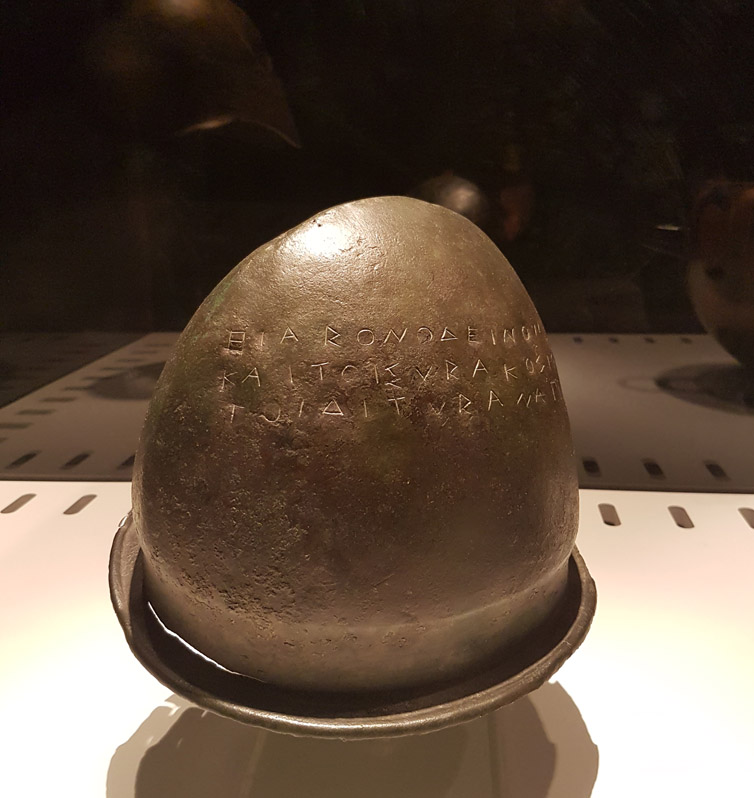
As we have seen, the empire of Sybaris went beyond the borders of the area directly marked by the sanctuaries. The foundation of Poseidonia made the Sybaris’ aims explicit to open a door on the Tyrrhenian Sea as close as possible to the flourishing Etruscan settlements of Campania, located just north of the Sele river, and at the same time, to control the communities of Oenotrians of the interior who, between the eighth and sixth centuries B.C. were able to consolidate and to take on the role of attractive business partners. These were small inhabited areas that were in close contact with Sybaris from whom they learnt the use of writing and the alphabet, as shown by the inscription on the “Castelluccio” olla-shaped jar and, above all, the “Tortora cippus”. It is a kind of “lex sacra” (sacred law) written in a palaeo-Italic language (the language of the Oenotrians), adapting and integrating the Achaean alphabet used by Sybaris and Poseidonia.
The same Oenotrian communities used a certain coinage named by the modern scholars the “coins of the alliance”. They were incuse coins (with hollow images), probably beaten at Sybaris, which presented on one side the retrospective bull (which looks backwards) and on the other side the names of the towns such as PAL-MOL (Palinuro and the nearby Molpa), SIRINO-PYXOES (Sirinos in the “Valle del Noce” and Pixunte in the Gulf of Policastro).
For the maintenance of this complex political-institutional organisation, Poseidonia played a very important role. That Sybarite colony represented the last bastion of Achaean Hellenism in front of the flourishing Etruscan centres north of the Sele river and privileged mediator with the communities of Oenotrians gravitating on the Tyrrhenian Sea. This role was reiterated on the occasion of the foundation of Velia (Herodotus, I, 167) – Poseidonia favoured the foundation of Velia by the Phocaeans – but also in the Olympia treaty where Poseidonia together with the Gods, was called to guarantee the pact between Sybarites and the Serdàioi.
But the great power of Sybaris did not hold up to the innovative thrusts that rose from the great mass of the lower-middle social classes, kept away from the many riches. Towards the end of the 6th century, B.C. riots led to the rise of the tyranny of “Telis”, who was so strongly anti-aristocratic that in 510 B.C. 500 Sybarite nobles were forced to find shelter in the oligarchic Kroton, asking and obtaining asylum. When Telis asked for them to be returned, Kroton – where a strongly influential figure was Pythagoras – refused. The result was a war that saw Sybaris badly defeated. After a siege of 70 days, the city itself was destroyed forever by the diversion of the Crathis (Crati) river which submerged the remains (Strabo, VI, C 263). In this regard, Domenico Mussi, an Italian historian (1934-2010), has rightly pointed out that this war was not a simple fight between neighbouring Greek “pòleis” (cities), but two “pòleis” with opposite political and institutional orientations.
The outcome of the war profoundly changed the political scenario of “Magna Graecia”, and radically changed the previous balance, weakening the Achaean cities. The indigenous populations economically and/or politically linked to Sybaris went through a critical period, as can be seen from the downsizing of many main centres and their necropolises and the end of the emissions of the “coins of the alliance”.

Excerpt from: Gioacchino Francesco La Torre, Sicilia e Magna Grecia , Editori Laterza, 2011, pp 84-90


For further info about our guided tours of Pompeii and Herculaneum
It is indeed impressive to note that, twice in the 7th century BC and in the 15th century AD, almost the same region of central Italy, ancient Etruria and modern Tuscany, was the decisive hotbed of Italian civilization.(1)

When in the VIII century BC the Greeks set foot on the coasts of Campania, they found it inhabited by populations who were different in language, customs and level of development, and they immediately established a relationship with them, now conflicting, now more or less friendly. The Greek historians of the Classical Age (480 B.C. – 323 B.C.), more attentive to the events of the Greek pòleis (cities), have  told us little or nothing about these local peoples, who appeared to them barbarous and, therefore, devoid of history. Only two names have been handed down from these various indigenous peoples, the  “Ausoni” and the “Opici”, sometimes assimilating them, more often distinguishing them. The “Ausoni”, of whom the “Aurunci” were considered to be descendants in historical times, lived between the “Liri” and “Volturno” rivers and were considered the first inhabitants of the region.  “Opici”, on the other hand, according to some modern historians, would reflect a later reality, the so-called “Fossakultur” (Culture of Fossa Tombs)  of the final Bronze Age (XI-X century BC) and of the early Iron Age (IX- VIII century BC). Of this period we have scarce archaeological evidence, above all the materials of the pre-ellenic necropolis of Cuma, the grave goods of the necropolis of the Sarno Valley (San Marzano, San Valentino Torio, Striano). On this indigenous substratum the “Villanovan culture” (from the burial ground of Villanova near Bologna which was  first identified by Giovanni Gozzadini in 1853), that practiced  cremation, developed.  It seems that  the “Villanovan culture” evolved a few centuries later directly within the Etruscan culture, which was certainly well distinguished also on the linguistic level by indigenous cultures. (2) It is important to underline that the  “Villanovan Culture”  practiced cremation: in this historical period – with the transition from the Bronze Age to the Iron Age, which began at the beginning of the IX century. B.C. – the first distinction among the different peoples which draws our attention comes from the various funeral rites practiced . (3) Strabo wrote (4): ” The Tyrrhenians had twelve cities in Etruria, twelve of which they founded near the Po river, witness Livio (5), and twelve they founded in “Opicia”, whose capital city was Capua.   (6) Capua is their metropolis, “head” of the others, according to the origin of its name. Since the others in comparison were small castles, except for Teano Sidicino. The Etruscan culture pervaded the entire interior of the Campania region, so that even the most peripheral Italic tribes, such as the Samnites of the interior, ended up assuming behaviors typical of the Etruscans, by considering the expansion of the more typical Etruscan products such as buccheri (typical Etruscan class of ceramics) and bronze objects. On the other hand, the same Greek border colonies such as Cuma and Poseidonia ended up receiving marked Etruscan influences, for example in the adoption of wooden architecture with terracotta decoration with bright colors. (7)


WHY ARE THE ETRUSCANS SO IMPORTANT TO UNDERSTAND THE ROMAN AND POMPEII HISTORY  ?

The study of the Etruscans is fundamental for understanding the Roman world in general and Pompeii in particular. The Etruscan civilization had a profound influence on Roman civilization, later merging with it. The Etruscans were present in Campania from the ninth century, B.C. and it was probably these people who favored the foundation of Pompeii. With their synecism (see Note), they favored aggregation in a single city, Pompeii, of the mythical “Sarrastri”, a people who previously lived scattered in hut villages along the banks of the Sarno river.


NOTE:

Synecism = It was originally the amalgamation of villages in Ancient Greece into pòleis, or city-states

BIBLIOGRAPHY:

  1. Jacques Heurgon, Vita quotidiana degli Etruschi, Editore:IL SAGGIATORE 1967, p. 23.
  2. Stefano de Caro Le culture della Campania antica preromana: gli Etruschi, i popoli italici e le loro città da Il Museo Archeologico Nazionale di Napoli – Electa Napoli 1994 pag. 33
  3. Gioacchino Francesco La Torre, Sicilia e Magna Grecia, Bari, Editori Laterza, 2011, pag 17
  4. Lib. V pag 373
  5. lib. V. C. 33
  6. Ibid.
  7. Stefano de Caro op. cit., p. 34


For further info about our guided tours of Pompeii and Herculaneum

The “Genius”, generally covered – even the head – by a “toga praetexta”, a white toga with a broad purple stripe on the border, is a tutelary deity linked to a person, to the head of the house, while the Lare is linked to the earth. Each person has his genius – women have a “Iuno” – who guards their nurturing power. The genius is generated and dies at the same time as man, and lives closely connected with him. On each anniversary, he is offered wine, incense and other bloodless gifts (such as focaccia).

The snake, which we often find painted below the domestic “sacellum” (shrine) – also coupled with a female snake, from which it is distinguished by the crest – is sacred to the Genius (as a symbol of nurturing power) and also enjoys the attention of man. These snakes are also painted on the external walls, which are thus protected. (1)

The Lares were tutelary deities who, according to tradition, were the children of Mercury and Lara, a nymph. It would seem that their name is of Etruscan origin and means “chiefs, princes” and originally they were tutelary deities of the fields and of individual farms. Over time they became protectors of the domestic hearth (from the Latin “Lar”, “hearth”) and each family had its own “Lare”. The Romans invoked the domestic “Lare” on all the important family anniversaries, for births, for weddings and when a family member left or returned from a trip. Unlike the “Penates”, the “Lares” were intimately linked to the home where their image was located. They were never removed from the house and they had the task of protecting it from dangers coming from outside. In ancient times a Roman had only one “Lar”, his protector, but later this tutelary deity was replaced by two or more and, merging with the “Mani”, they became the personification of the souls of the good-hearted deceased who protected the house from evil spirits. (2) The “Lares” also were represented in twos: in Pompeii they were often arranged symmetrically on the sides of the “Genius”, young and moving as if they were guiding the dances in their cheerful parties: “laralia” or “compitalia”, celebrated at the intersections of the streets (compita).

Associated with them are the Penates, protector deities of the “penus” (the food pantry), and therefore of the general well-being of the home. Along with the “Lares”, they were considered protectors of the family and when the family moved house, the images of the “Penates”- two statuettes placed next to the hearth in a special cabinet – were transported from one house to another. Over time, other divinities with tutelary functions were added to the two original “Penates”, such as Mercury, Neptune, Jupiter, Juno and Minerva, whose image was placed next to that of the “Penates”. Even the State, considered as a large family, had its “Penates”, which were kept in the temple of Vesta and called “Major” or “Public Penates” to distinguish them from those of the family, called “Minor” or “Private Penates”, and placed next to the domestic hearth. (3)

The “Mani” were the souls of the dead who had been good-hearted in life (“manus”, in archaic Latin means “good”), and the same term was used to indicate the underworld deities and the tutelary genies of the dead. As mentioned above, over time the “Mani” merged with the “Lares”, becoming the personification of the souls of the good-hearted deceased who protected the house from evil spirits. The cult of the “Mani” was imposed by one of the laws of the “Twelve Tables”. In their honor, festivals called “Feralia” and “Parentalia” were celebrated in February. (4)

BIBLIOGRAPHY:

1) Eugenio La Rocca, Mariette e Arnold de Vos, Guida archeologica di Pompei, Arnoldo Mondadori Editore, 1976, pag. 273
2) Corrado D’Alesio, Dei e Miti, Edizioni Labor, Milano, 1954, pag. 422
3) Ibid., pag. 563
4) Ibid., pag. 447


For further info about our Pompeii and Herculaneum private tour


The Greek  Sanctuaries can be:

  1. a) Intramural
  2. b) Periurban
  3. c) Extraurban


Their location was linked to methods and needs that varied from city to city and that underwent evolution over time.


Urban and Periurban Sanctuaries:


They were preferably located on the “Acropolis”, citadel built on a high hill, but also in the same “agorài” (main squares), and then along the line of fortifications, to define a sort of “sacred belt”, or, in the case of coastal cities, at the mouth of the rivers, near ports and landings.


Extraurban Sanctuaries:


The “pòlis”, from the moment of its establishment in a foreign land, in addition to carving out a large urban space clearly oversized for the needs of the first comers, subtracted from the natives and also annexed a portion of territory outside the city. This space, functional to finding food resources, was the “chòra politikè”, an essential part, together with the city, of the “polis” political institution. Therefore, exactly as in the mother country, from the beginning the colonial “pòlis” was composed of an inseparable unity between the city (àstu) and that portion of the territory directly subjected to the government of the city (chòra politiké), dotted with sanctuaries from the earliest phase and variously articulated over timeSince the first generations,  the main extra-urban sanctuaries were almost never more than 10-12 km away from the city: it suggests that the size of the most ancient “chòra” allowed farmers however to reach their property (in the “chòra politiké”), to work the land and to return in city ​​over the same day.


Chòra Politiké:


It is clear how the best portion of the “chòra” was divided and assigned to the colonists according to a very well regulated property regime, of which we also have extraordinary testimonies of an economic-juridical or cadastral nature, although much later – the Tables of Eraclea (1), the Tables of the Sanctuary of Zeus Olympios of Locri or the Alesina Table. It is equally clear how at the edge of the divided and assigned countryside there was the “eschatià”, that is a sort of no-man’s land set against the indigenous territories or a neighbouring “pòlis”.

It is important to underline that the limits of the colonial territories towards the wooded areas of the “eschatià” and those inhabited by the indigenous populations were not well defined. Along the coast, on the other hand, especially in the case of (A remove) direct proximity between two neighbouring “pòleis”, the borders had to be established more strictly, so that the historical sources refer to border conflicts, trespassing and raids in the enemy territory, similarly to as documented for the motherland. In these cases the borders were often marked by natural elements, especially rivers, also sometimes marked by the sacred.

The sacred mediated between the Greeks and the indigenous communities of the hinterland, in those very permeable areas, defined as frontiers, in which the meeting of the different cultures became more fruitful and where the interests of the indigenous aristocracies were united with those of the dominant classes of the colonial “pòleis”.


Excerpt  from:  Giocacchino Francesco La Torre, Sicilia e Magna Grecia, Editori Laterza, 2011, pp. 157-160


For further info about our guided tours of Pompeii and Herculaneum


Wine was the most widespread drink and certainly the most loved by the Romans in their daily diet and an important element of convivial moments. The Romans had compiled real classifications of the finest wines, among which Falerno excelled, but Surrentinum and  Vesbius or Vesuvinum also enjoyed a good reputation. Particularly appreciated wines were also those produced in Greece and in the Aegean islands, for example the lyttios, greatly appreciated by the Pompeians, as shown by the amphorae of particular shapes found and the inscriptions read on them. The wine was never drunk pure, but generally served with water, hot or cold depending on the season. Furthermore, liqueur wines such as mulsum -the best mulsum was obtained from the must -, passum and defrutum were produced. Defrutum was a condiment based on reduced must used by cooks of ancient Rome; together with garum it was one of the most used sauces in the preparation of all sorts of dishes. Poor drinks were lora, obtained from maceration in water of the pressed marc (vinacce) and  posca, a drink of water and vinegar.

From the wine sold in Pompeian thermopolia (wine bars) we also know the cost, reported by the inscription CIL IV 1679: “Hedoné proclaims: Here we drink for only one axis; with two you will drink better wine; with four you’ll drink Falerno ”. (1)

Most of the wine consumed in the cities was made locally. At least forty local farms and estates had cellae vinariae or wineries, some producing on an enormous scale. These estates are characterized by a large number of dolia (large earthenware vase), buried up to the rim (defossa), in which the wine was stored as it matured. “Villa Regina” at Boscoreale had eighteen of these. Some were for olives and grain, but the vast majority contained wine. Many of them were still capped with terracotta lids and sealed with mortar, showing they were full when the eruption happened. The wine remained in dolia until the following year, when it was sold or taken to the owner’s house in the city. The transportation of large quantities of wine required considerable effort, as each dolium could hold over twenty amphoras’ worth (about 120 gallons or 545 litres). In Pompeii, in front of the Forum Thermal Baths, we have also found a thermopolium where on one of its dolia (large jars), used for fermenting wine, the name “A Apulei Hilarionis” (“of A. Apuleius Hilarion”) was stamped.

Amphorae often carried a painted inscription. Some were basic, like those on the amphorae from Villa della Pisanella marked RUBR(um) = rubrum, the Latin for “red”. Others served as address labels. A fragment of an amphora from Pompeii bears the words, “For Albucia Tyche at Pompeii”, suggesting Albucia was a landlady. (2)


BIBLIOGRAPHY:

  1. Grete Stefani, Michele Borgongino, Cibus. L’alimentazione degli antichi romani. Le testimonianze dell’area vesuviana in AAVV Cibi e Sapori a Pompei e Dintorni , Soprintendenza Archeologica di Pompei, Edizioni Flavius,  2005, pp. 77-78
  2. Paul Roberts, Life and death in Pompeii and Herculaneum, The British Museum Press, 2013, pp. 66-68

For further info about our guided tours of Pompeii and Herculaneum